Showing posts with label NLP. Show all posts
Showing posts with label NLP. Show all posts
Wednesday, 28 November 2012

Thursday, 22 November 2012
Cartier a winter tale
Another beautiful spot from cartier:
http://www.youtube.com/watch?v=9RZPmKC2c2o
http://www.youtube.com/watch?v=9RZPmKC2c2o
Tuesday, 20 November 2012
Wednesday, 14 November 2012
Thursday, 8 November 2012
Monday, 15 October 2012
Museum of old beliefs - The theory
The museum of old beliefs was developed by Robert Dilts and is used to change limiting beliefs using spatial anchors.
Therefore print out sheets for each of the below:
Meta
Open to doubt
Used to believe
Museum of old beliefs
Open to believe
Believe
Trust
The Meta position is basically the neutral position and starting point.
The person then steps on the "Open to doubt" position. In that position, the person needs to go back to a time and moment in which he/she was open to doubt and describe that using visual, auditory and kinaesthetic language. This should now be anchored to that position.
Next step: "Used to believe". In here he/she needs to anchor the feeling of what he/she used to believe the same way it was done for "open to doubt".
Next step: "Museum of old beliefs"- In here he/she describes a place that will be used to leave an old belief behind. This could be a museum, the sea or whatever the person wants it to be. That place should be described as detailed as possible. The person then takes the limiting belief and puts it away. Turn that limiting belief into a positive one (example: "I am not good enough to do that" into "I trust my capabilities and know I will be able to do it") and step into "Trust".
Next step: "Trust" - He/she anchors the positive belief, trusting himself/herself.
Next step: "Open to believe" - This is about anchoring a moment/situation in which the person was open to believe. Best to refer to the new positive belief.
Next step: "Believe" - The person anchors now the new positive belief fully.
Step back into "Meta" position.
You will see the person will be empowered and wants to take some action.
When to use this technique:
Changing limiting beliefs about yourself or someone else
Diminish doubts
Change negative beliefs into positive ones
Therefore print out sheets for each of the below:
Meta
Open to doubt
Used to believe
Museum of old beliefs
Open to believe
Believe
Trust
The Meta position is basically the neutral position and starting point.
The person then steps on the "Open to doubt" position. In that position, the person needs to go back to a time and moment in which he/she was open to doubt and describe that using visual, auditory and kinaesthetic language. This should now be anchored to that position.
Next step: "Used to believe". In here he/she needs to anchor the feeling of what he/she used to believe the same way it was done for "open to doubt".
Next step: "Museum of old beliefs"- In here he/she describes a place that will be used to leave an old belief behind. This could be a museum, the sea or whatever the person wants it to be. That place should be described as detailed as possible. The person then takes the limiting belief and puts it away. Turn that limiting belief into a positive one (example: "I am not good enough to do that" into "I trust my capabilities and know I will be able to do it") and step into "Trust".
Next step: "Trust" - He/she anchors the positive belief, trusting himself/herself.
Next step: "Open to believe" - This is about anchoring a moment/situation in which the person was open to believe. Best to refer to the new positive belief.
Next step: "Believe" - The person anchors now the new positive belief fully.
Step back into "Meta" position.
You will see the person will be empowered and wants to take some action.
When to use this technique:
Changing limiting beliefs about yourself or someone else
Diminish doubts
Change negative beliefs into positive ones
Sunday, 14 October 2012
What is NLP?
This post is my attemtpt to explain what NLP (Neuro Linguistic Programming) is.
There are of course explanations in every book. They are like this:
Neuro - refers to the nervous system. Our experience of the world enters the brain via the nervous system and the five senses. Neuro stands for how we process this sensory experience and translate it into conscious and unconscious thoughts
Linguistc - refers to language. We communicate on unconscious and conscious level - verbally and non-verbally.
Programming - indicates the was in which we consistently think and behave. Each of us runs specific programms to produce our behaviour. Programms consist of a series of steps that automatically produce certain behaviour. NLP can reveal the programmes you run and results they produce. It also gives you the means to change your own and other people's programmes to produce the results you want.
This is my explanation I give to people when they ask me what it is:
NLP stands for Neuro Linguistic Programming.
It touches science going into how the brain works and processes information.
It helps you understand how people tick by looking at their language (bodylanguage and actual words) and actions. With that understanding you can improve your communication with others. You can also lead them to a certain direction and influence them to a certain degree.
You can use NLP techniques in your everyday life and/or use it to help others to change their perception and therefor behaviour. It is very useful in professional life as well.
Various NLP techniques are often used by coaches to achieve an agreed outcome.
Please note that there is much more to NLP than the explanation above but it gives you an idea about it if you have never heard of it before.
In future posts I will explain NLP techniques and share my experience with them.
There are of course explanations in every book. They are like this:
Neuro - refers to the nervous system. Our experience of the world enters the brain via the nervous system and the five senses. Neuro stands for how we process this sensory experience and translate it into conscious and unconscious thoughts
Linguistc - refers to language. We communicate on unconscious and conscious level - verbally and non-verbally.
Programming - indicates the was in which we consistently think and behave. Each of us runs specific programms to produce our behaviour. Programms consist of a series of steps that automatically produce certain behaviour. NLP can reveal the programmes you run and results they produce. It also gives you the means to change your own and other people's programmes to produce the results you want.
This is my explanation I give to people when they ask me what it is:
NLP stands for Neuro Linguistic Programming.
It touches science going into how the brain works and processes information.
It helps you understand how people tick by looking at their language (bodylanguage and actual words) and actions. With that understanding you can improve your communication with others. You can also lead them to a certain direction and influence them to a certain degree.
You can use NLP techniques in your everyday life and/or use it to help others to change their perception and therefor behaviour. It is very useful in professional life as well.
Various NLP techniques are often used by coaches to achieve an agreed outcome.
Please note that there is much more to NLP than the explanation above but it gives you an idea about it if you have never heard of it before.
In future posts I will explain NLP techniques and share my experience with them.
Wednesday, 10 October 2012
Pizza Hut - Pizza for life
Good idea: Get Pizza for Life if you ask the president at thenext debate what kind of pizza they like:
http://adage.com/article/creativity-pick-of-the-day/presidential-candidates-pie-toppings-prefer-pizza-hut-life/237660/?utm_source=daily_email&utm_medium=newsletter&utm_campaign=adage
http://adage.com/article/creativity-pick-of-the-day/presidential-candidates-pie-toppings-prefer-pizza-hut-life/237660/?utm_source=daily_email&utm_medium=newsletter&utm_campaign=adage
Tuesday, 9 October 2012
Saturday, 6 October 2012
NLP Practitioner
Wow, haven't really written much in that section yet. There was just too much I did at once, I think. But now I will focus on NLP and start integrating it in my life properly.
I have done a two day NLP Diploma course in January this year with a friend of mine. It was really good and it was for free. They offer you to do the entire NLP Practitioner programm afterwards if you are interested. And I was - a lot. So I booked the entire course and attended the rest of the 7-day course in May this year.
This is the company I did the course with:
http://www.free-nlp.co.uk/
And I highly recommend them. They offer so much knowledge and they are definatley worth the money. Not only can you do the course and do the advanced and Master Practitioner afterwards - No, you also get a life long support by them, access to a members area with lots more information, training software etc. and access to all their online courses. I will do my Coaching Practitioner with them as well.
Anyway, in order to get my certificate of the NLP Practitioner I have to finish three kinds of written work. I have already finished two of them and will have soon the third part. The other important thing about NLP is that you keep practicing and integrate it in your life properly. I have to admit, I haven't done that so far. I mean, I see how it already helped me with a lot of things in my life and I am much more aware of language etc. but I haven't integrated it properly and it doesn't come naturally so far.
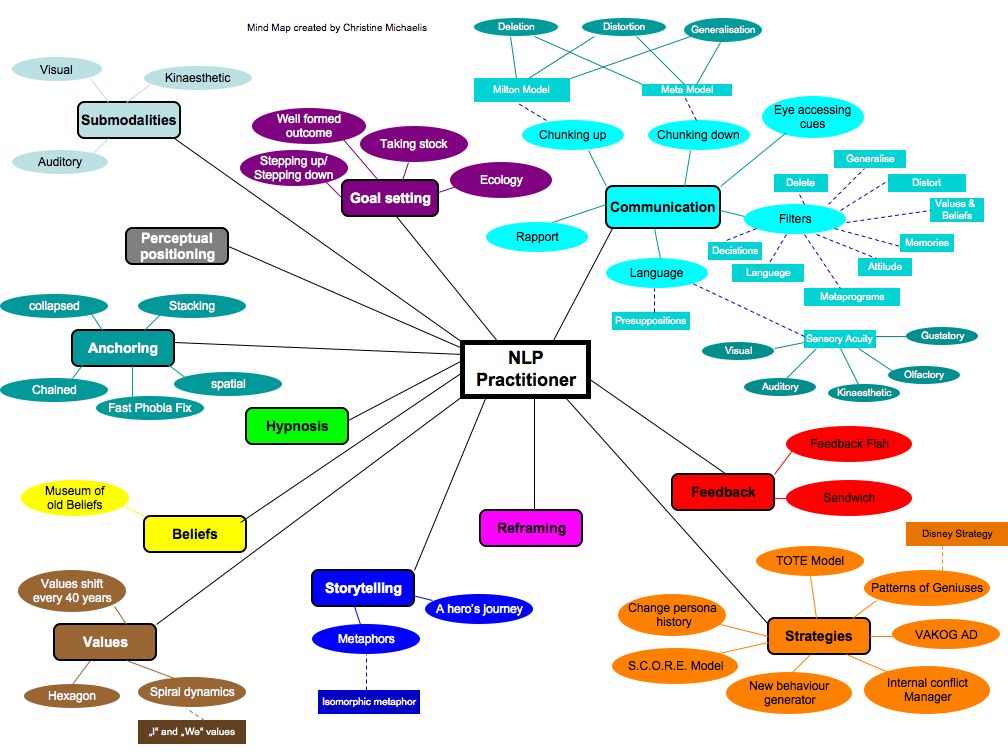
Looking closer at mind mapping, I discovered that this is something that really works well for me. That is why I have created two mind maps for this NLP course: One for the first two days (Level1) and one of the other 5 days (Level2). I would like to share these mid maps with you.
Looking at them, will make you see how much we got covered within that course.
I will write on a regular basis.
Christine


I have done a two day NLP Diploma course in January this year with a friend of mine. It was really good and it was for free. They offer you to do the entire NLP Practitioner programm afterwards if you are interested. And I was - a lot. So I booked the entire course and attended the rest of the 7-day course in May this year.
This is the company I did the course with:
http://www.free-nlp.co.uk/
And I highly recommend them. They offer so much knowledge and they are definatley worth the money. Not only can you do the course and do the advanced and Master Practitioner afterwards - No, you also get a life long support by them, access to a members area with lots more information, training software etc. and access to all their online courses. I will do my Coaching Practitioner with them as well.
Anyway, in order to get my certificate of the NLP Practitioner I have to finish three kinds of written work. I have already finished two of them and will have soon the third part. The other important thing about NLP is that you keep practicing and integrate it in your life properly. I have to admit, I haven't done that so far. I mean, I see how it already helped me with a lot of things in my life and I am much more aware of language etc. but I haven't integrated it properly and it doesn't come naturally so far.
Looking closer at mind mapping, I discovered that this is something that really works well for me. That is why I have created two mind maps for this NLP course: One for the first two days (Level1) and one of the other 5 days (Level2). I would like to share these mid maps with you.
Looking at them, will make you see how much we got covered within that course.
I will write on a regular basis.
Christine

Monday, 1 October 2012
Subscribe to:
Posts (Atom)